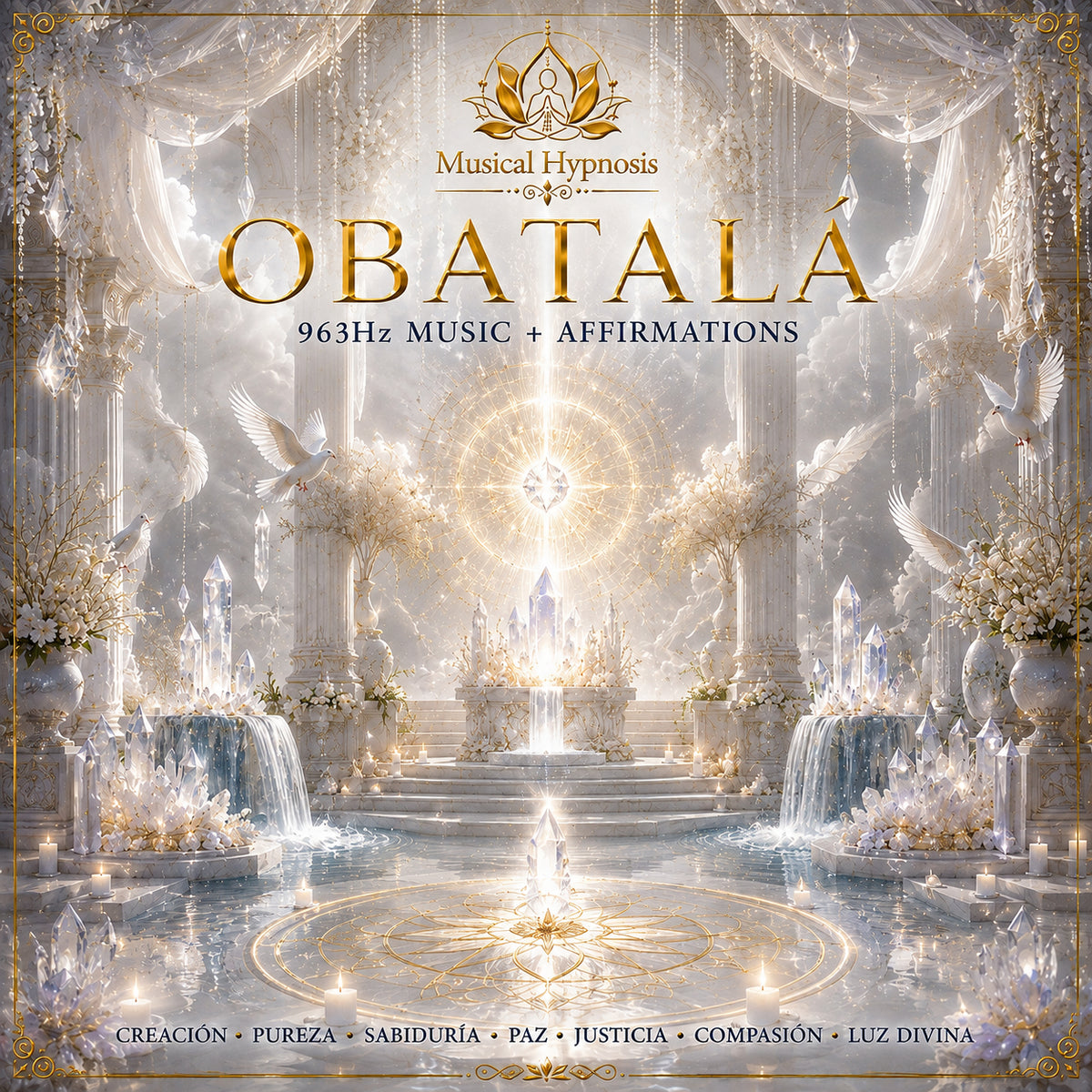
Return to Stillness: Obatalá & 963 Hz Meditation for Peace and Clarity
Introduction
Sometimes the world becomes so loud that you can no longer hear your own wisdom. Thoughts crowd together. A decision asks for an answer. Your heart longs for peace, but the harder you search for clarity, the further away it seems.
What if the next step were not to search harder, but to become still?
Throughout ancient spiritual traditions, stillness has been treasured as a pathway toward wisdom, patience, self-awareness, and a deeper understanding of life.
Among the sacred figures associated with these qualities is Obatala, an Orisha whose presence connects the ancestral wisdom of the Yoruba people with the living spiritual traditions of the Latin Caribbean.
Obatala invites us to consider a beautiful possibility: that wisdom does not always arrive through effort, that compassion can be a form of strength, and that sometimes the clearest answers emerge when we allow the mind to become quiet.
Accompanied by the spiritual symbolism of the 963 Hz Solfeggio frequency, this reflection explores the relationship between creation, divine balance, meditation, and the timeless wisdom of stillness.
Who Is Obatala? Origins in Yoruba and Latin Caribbean Traditions
Obatala is one of the revered Orishas of the Yoruba spiritual traditions of West Africa, particularly associated with creation, wisdom, purity, patience, dignity, and peace.
In Yoruba accounts of creation, Obatala is closely associated with the formation of human beings and the sacred responsibility of creation. These teachings emphasize not only the power to create but also the wisdom, patience, and responsibility required to care for what has been created.
Obatala's spiritual heritage extends far beyond West Africa.
Through generations of cultural transmission, Yoruba religious traditions became deeply rooted in the Latin Caribbean, including spiritual communities in Puerto Rico and Cuba, where these traditions continue to flourish.
In Cuba, these traditions developed through Lucumi, also known as Regla de Ocha or Santeria, where the Orishas remain central to living spiritual practices.
For many people throughout the Latin Caribbean, Obatala represents a sacred connection between ancestral heritage, spiritual wisdom, compassion, and the enduring search for harmony.
White is especially associated with Obatala, symbolizing purity, clarity, peace, and spiritual composure.
These associations are reflected in white garments, sacred imagery, and expressions of reverence that evoke serenity and dignity.
Yet Obatala's significance reaches beyond outward symbols.
At the heart of this spiritual presence lies a profound teaching: true wisdom is accompanied by patience, compassion, humility, and responsibility.
Obatala: The Great Creator and Divine Creatrix
One of the most fascinating aspects of Obatala is the diversity of sacred manifestations honored across Yoruba and Latin Caribbean spiritual traditions.
In many Yoruba traditions, Obatala is represented through a masculine creator identity. Within Latin Caribbean traditions, including Puerto Rican spiritual communities and Cuban Lucumi, Obatala is also honored through masculine and feminine caminos, meaning spiritual paths or manifestations.
Some of these paths include masculine manifestations such as Ayaguna and feminine manifestations such as Oshanla and Obanla.
These traditions remind us that sacred identity can carry layers of meaning, and that spiritual understanding may be expressed differently across cultures, communities, and religious lineages.
Within the artistic and spiritual vision of Musical Hypnosis, the Great Creator is also the Divine Creatrix—one infinite sacred presence encompassing masculine and feminine energies while transcending the boundaries of either.
Here, Creator and Creatrix are not separate beings competing for power or identity.
They are envisioned as one indivisible presence, expressing the wholeness of creation.
Strength and gentleness.
Wisdom and compassion.
Stillness and possibility.
Creation and nurturing.
These qualities need not exist in opposition.
A person may be strong without becoming harsh, compassionate without surrendering discernment, and patient without abandoning purpose.
In this understanding, divine balance becomes an invitation to recognize the many qualities that can coexist within ourselves.
Obatala's masculine and feminine manifestations provide a meaningful spiritual inspiration for reflecting upon this unity.
The Creator and Creatrix are one sacred presence, whole and indivisible.
The Sacred Symbolism of White: Purity, Clarity, and Peace
White holds a particularly meaningful place in the spiritual imagery associated with Obatala.
It evokes clarity, composure, dignity, purification, and peace.
Imagine entering a magnificent sanctuary of white marble, luminous crystals, soft candlelight, and gentle silence.
The space feels open and peaceful.
There is nothing demanding your attention.
Nothing requiring an immediate answer.
Nothing insisting that you become someone other than who you are.
The white light becomes a symbol of mental clarity, while the stillness invites you to release unnecessary distractions.
In this symbolic sanctuary, purity does not mean perfection.
It suggests the possibility of returning to what is essential.
A clear intention.
A compassionate heart.
A thoughtful decision.
A moment of peace.
Obatala's symbolism reminds us that clarity is not always found by adding more thoughts, but sometimes by allowing unnecessary noise to fall away.
And within that quiet, understanding may begin to emerge.
What Is 963 Hz? A Frequency for Spiritual Reflection
Within contemporary Solfeggio meditation practices, 963 Hz is associated with higher consciousness, spiritual connection, illumination, unity, and divine awareness.
Often called the frequency of divine connection, 963 Hz has become a meaningful part of modern spiritual listening practices centered on contemplation, inner awareness, and the search for deeper understanding.
Its associations with unity and illumination make it a beautiful companion to reflections on Obatala's wisdom, patience, purity, and sacred balance.
Meditation music incorporating 963 Hz may be used to create a contemplative atmosphere in which listeners can become more attentive to their thoughts, intentions, and inner experiences.
Some prefer quiet instrumental soundscapes.
Others enjoy the grounding presence of rhythmic drums, the gentle breath of a flute, or affirmations that encourage peaceful reflection.
There is no single experience everyone must have.
For some, meditation begins with the rhythm of a drum.
For others, it begins with a quiet breath.
And sometimes, it begins with the simple decision to stop searching for answers long enough to listen inward.
Become still. Listen. Allow clarity to unfold in its own time.
The Wisdom of Stillness: Finding Peace Without Forcing Answers
Stillness is often mistaken for inactivity.
Yet becoming still does not mean giving up, avoiding responsibility, or refusing to make decisions.
Sometimes stillness is one of the most thoughtful actions we can take.
Consider a moment when emotions are running high.
A difficult conversation has left you unsettled.
An important decision feels overwhelming.
Your thoughts move rapidly between possible outcomes, each one demanding attention.
The instinct may be to think harder, respond faster, or force an immediate resolution.
But what happens when you pause?
When you allow yourself a moment of quiet, you create room to observe your thoughts rather than react to every one of them.
You may begin to recognize what truly matters, what deserves your attention, and what can wait.
This is one of the beautiful lessons reflected in Obatala's association with wisdom and composure.
Patience is not weakness. Gentleness does not diminish strength. And wisdom does not always need the loudest voice.
Stillness offers an opportunity to practice discernment—the ability to consider what is meaningful, constructive, and aligned with your values.
It invites you to approach yourself with the same compassion you might offer someone you love.
And it reminds you that not every question requires an immediate answer.
Some understanding unfolds gradually.
Some decisions become clearer with time.
Some moments ask only that you become still enough to recognize the wisdom already within you.
Masculine and Feminine Energy: The Beauty of Divine Balance
The symbolism of masculine and feminine energy appears in many spiritual and philosophical traditions, although its meanings vary across cultures.
Within this reflection on Obatala, these energies are not treated as limitations of biological identity or fixed rules about how someone should behave.
Instead, they offer a symbolic way of exploring qualities that may coexist within every person.
Strength can be compassionate.
Leadership can be humble.
Courage can be gentle.
Creativity can emerge from both action and stillness.
The masculine and feminine manifestations honored in some Latin Caribbean traditions inspire a particularly meaningful contemplation of these qualities.
Rather than imagining creation as a struggle between opposing forces, we may envision it as an expression of harmony.
A sacred balance in which different qualities contribute to one greater whole.
This is the inspiration behind the Musical Hypnosis interpretation of Obatala as the Great Creator and Divine Creatrix.
One presence.
One consciousness.
One sacred source.
The lesson is not that we must become masculine or feminine.
It is that we can embrace the fullness of our humanity without being confined by either.
Within wisdom, gentleness and strength may live together.
How to Practice Stillness in Everyday Life
Meditation does not require an elaborate ritual or a perfectly silent environment.
Sometimes a few intentional moments are enough to begin.
Here are several gentle ways to welcome more stillness into your day.
Begin With a Quiet Breath
Find a comfortable place to sit.
Allow your shoulders to relax.
Breathe naturally and bring your attention to the present moment.
You do not need to control every thought.
Simply notice when your attention wanders and gently return to your breathing.
Reflect Before Making a Decision
When faced with an important choice, give yourself permission to pause.
Consider what matters most to you.
Ask whether your next action reflects your values, responsibilities, and long-term intentions.
Stillness can create room for thoughtful reflection before action.
Practice Compassion Toward Yourself
Notice how you speak to yourself when something goes wrong.
Would you use those same words with someone you care about?
Try replacing harsh judgment with understanding.
You can acknowledge a mistake while still recognizing your ability to learn and grow.
Listen to Meditation Music
Music can help establish a peaceful atmosphere for contemplation.
Gentle melodies, steady percussion, flutes, and soft ambient textures can accompany quiet breathing, journaling, or personal reflection.
You may also explore frequencies such as 963 Hz within your meditation practice, allowing their spiritual symbolism to become part of your intention.
Create a Personal Moment of Peace
Light a candle in a safe place.
Sit near a window.
Spend a few moments surrounded by nature.
Write a thought in your journal.
Or simply close your eyes and listen to the sounds around you.
Stillness can become a meaningful part of everyday life without needing to look the same for everyone.
The invitation is simple: allow yourself a moment to be present.
A Reflection on Obatala's Blessing
Imagine standing within Obatala's sanctuary, surrounded by luminous white crystals, soft light, and an atmosphere of profound peace.
There is no urgency here.
No demand for perfection.
Only an invitation to remember the qualities that help guide a thoughtful and compassionate life.
Wisdom in your thoughts.
Patience along your path.
Integrity in your decisions.
Compassion within your heart.
These qualities are not distant ideals reserved for extraordinary people.
They can be practiced through ordinary moments.
A kind word.
A thoughtful choice.
A willingness to listen.
The courage to admit when you have been mistaken.
The patience to begin again.
Obatala's association with wisdom, purity, creation, and peace offers a beautiful reminder that the way we live may be just as meaningful as the answers we seek.
And perhaps one of the greatest lessons of stillness is recognizing that we do not need to possess every answer to walk forward with dignity and purpose.
Sometimes clarity begins not with certainty, but with compassion.
Sometimes wisdom begins with listening.
And sometimes peace begins with a single quiet moment.
Enter Obatala's Temple: A Musical Hypnosis Divine Journey
If these reflections resonate with you, you are invited to continue your experience through Obatala • 963 Hz Music + Affirmations, a Musical Hypnosis Divine Journey inspired by the wisdom, peace, and sacred balance associated with Obatala.
Deep shamanic drumming, earthy ceremonial percussion, soulful flute melodies, and the 963 Hz Solfeggio frequency create an atmosphere for meditation and spiritual reflection.
The affirmation versions bring together masculine and feminine voices speaking the same sacred words in unison, reflecting the Great Creator and Divine Creatrix as one presence.
Three complete 30-minute journeys are included:
-
Obatala • 963 Hz Music — Instrumental meditation music with the 963 Hz Solfeggio frequency.
-
Obatala • 963 Hz Music + Audible Affirmations — Masculine and feminine voices united in affirmations of peace, clarity, patience, and wisdom.
-
Obatala • 963 Hz Music + Subliminal Affirmations — The united affirmations woven quietly beneath the music.
Enter Obatala's Temple — Explore the 963 Hz Meditation Journey
Complete three-journey collection: $8.88 USD.
Welcome to Musical Hypnosis.
Awaken your mind. Heal your heart. Elevate your soul.